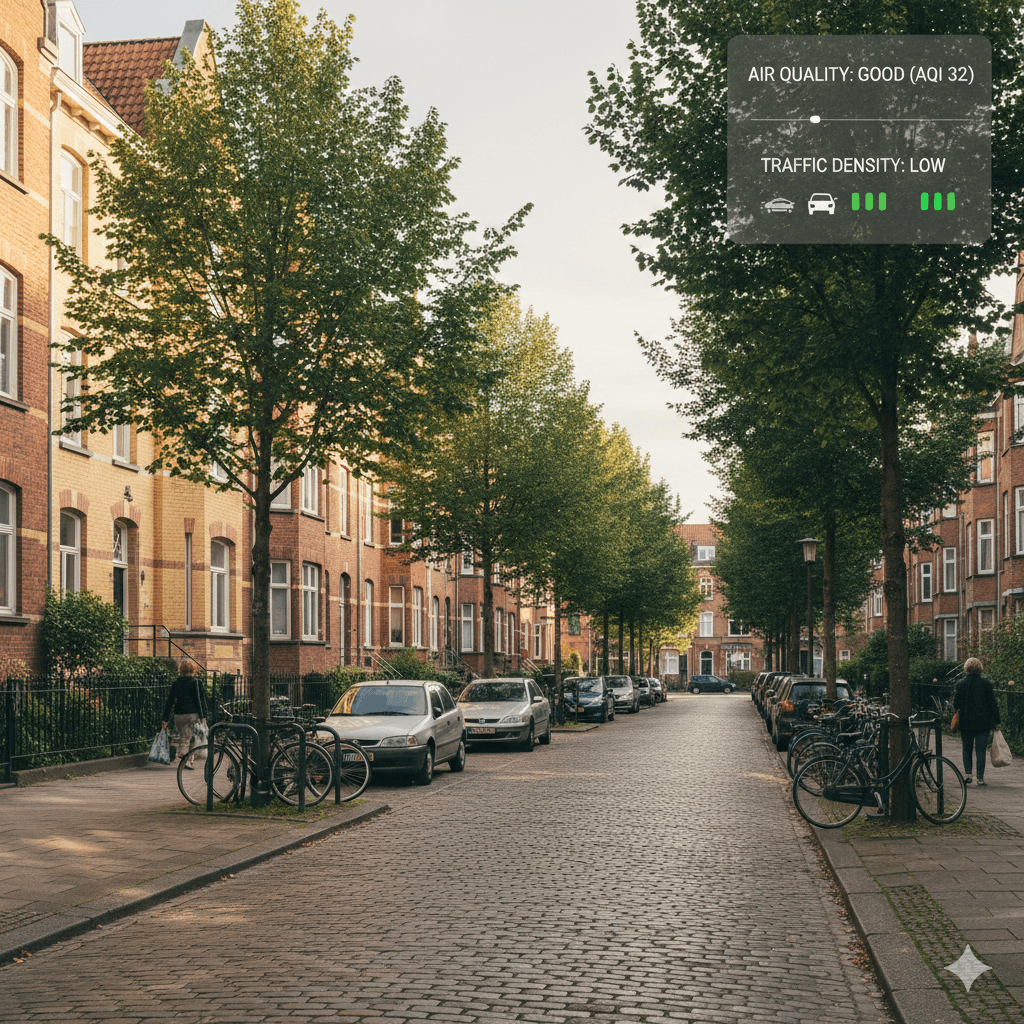
Is This Neighborhood Healthy? How to Check Air Quality & Living Risks
Is This Neighborhood Healthy? How to Evaluate Where You Live
Choosing where to live is no longer just about price, size, or location. Today, people increasingly ask a deeper question:
Is this neighborhood actually healthy to live in?
Air pollution, traffic exposure, noise, urban density, and access to green space all directly impact long-term health, sleep quality, and even child development. Yet most real estate platforms don’t show these risks clearly.
In this guide, you’ll learn how to objectively evaluate the health of a neighborhood using real environmental data.
🌬️ 1. Check Air Quality Near Your Home
Air pollution is one of the most important health indicators. In the Netherlands, nitrogen dioxide (NO₂) and particulate matter (PM10 / PM2.5) are the main pollutants linked to:
Asthma and respiratory issues
Cardiovascular disease
Reduced life expectancy
Poor sleep quality
Living close to busy roads significantly increases exposure.
What to look for:
Average NO₂ concentration below 40 µg/m³ (EU limit)
Distance from major roads and highways
Historical pollution trends, not just today’s weather
🚗 2. Measure Traffic Exposure
Traffic doesn’t only mean noise — it also means continuous emission exposure.
High traffic density increases:
Fine particle pollution
Noise stress
Accident risk
Lower outdoor comfort
A healthy neighborhood usually has:
Limited through-traffic
Residential streets instead of arterial roads
Safe walking and cycling routes
🏙️ 3. Evaluate Urban Density
High building density affects:
Air circulation
Heat buildup in summer
Noise reflection
Limited green space access
Dense areas aren’t necessarily bad — but extremely dense zones often show higher pollution and lower environmental comfort.
🌱 4. Look for Green and Child-Friendly Indicators
Green space improves:
Mental health
Air quality buffering
Temperature regulation
Physical activity
Families should also consider:
Distance to parks and playgrounds
Safe pedestrian zones
Traffic separation near schools
📊 5. Use Data Instead of Guesswork
Most people rely on impressions or local opinions — which can be misleading.
A better approach is using objective data from:
Government air quality sensors
Road networks and traffic density
Building density datasets
Environmental zoning data
This is exactly what Healthy Home Score by bold textSmartHood analyzes automatically.
🏡 Try Healthy Home Score
With one address, you instantly get:
✅ Air Quality Score
✅ Traffic Exposure Score
✅ Urban Density Score
✅ Environmental Health Insights
✅ Map visualization
✅ Downloadable report
👉 Check your neighborhood now at SmartHood.